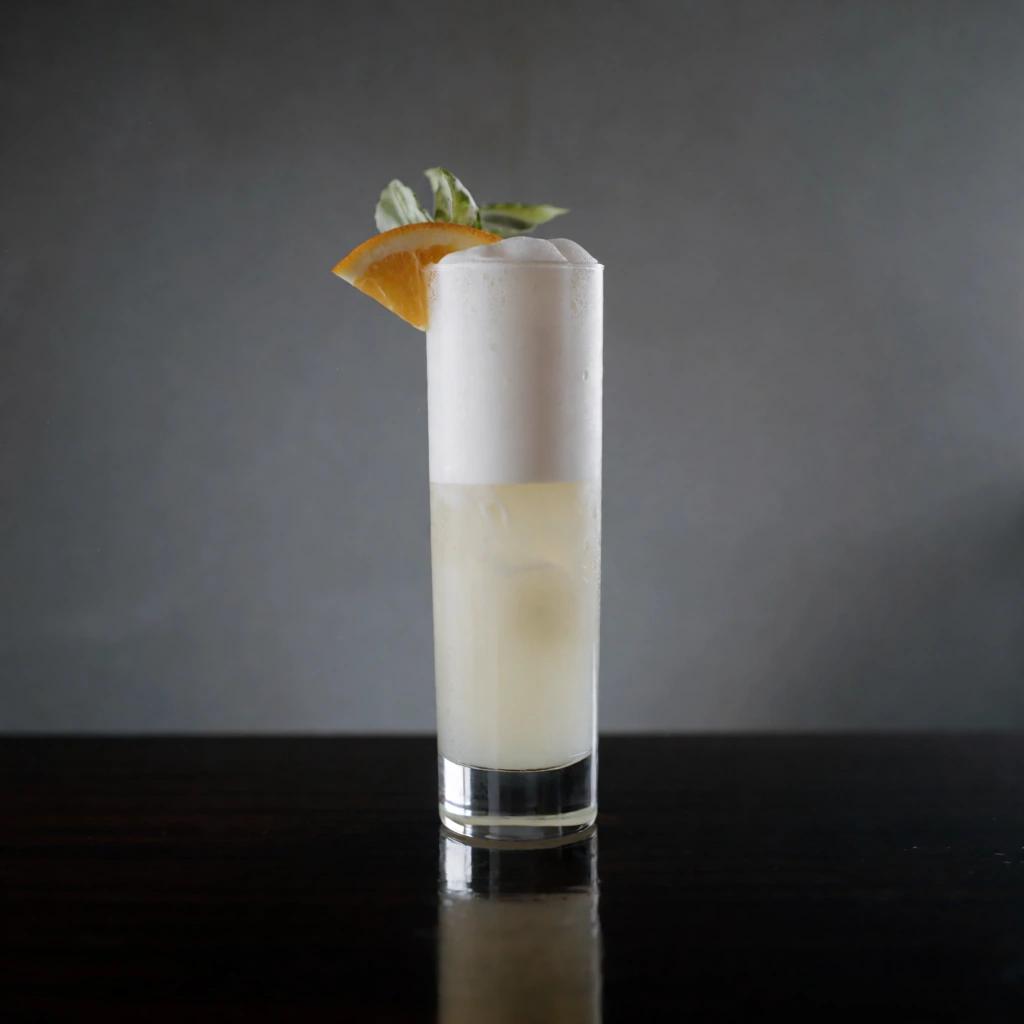
Somewhere in New Orleans, in a long-gone saloon on Gravier Street, a man named Henry Charles Ramos decided that a cocktail worth drinking was worth suffering for — and that the suffering, specifically, should belong to someone on his payroll. The Ramos Gin Fizz was born in 1888, and it arrived not as a recipe but as a spectacle.
Ramos ran the Imperial Cabinet Saloon with the particular obsession of someone who had convinced himself that twelve minutes of continuous shaking was not unreasonable. During Mardi Gras, when the city's thirst outpaced any single pair of arms, he deployed what can only be described as a shaking brigade — a line of young men, each taking the same tin for a stretch before passing it down the row, an early and deeply New Orleans interpretation of assembly-line production. The drink demanded it. Cream, egg white, citrus, orange blossom water, vanilla — these things do not simply combine. They have to be coerced, worn down, persuaded into something unified. The foam that results is less a garnish than a structural event.
The extended dry shake — before the ice ever enters the picture — is the non-negotiable act of faith at the drink's center. It is what transforms protein and fat into something with the body of a soft meringue. Skip it, or shorten it, and you have a perfectly decent creamy gin drink. You do not have a Ramos Gin Fizz. This distinction matters, and the drink has spent most of its life defending it against the impatient.
Prohibition arrived and Ramos, rather than pivot, simply closed. He had built the drink around a precise process and specific materials, and the calculus didn't survive the substitutions that underground bars required. This is not quite a tragedy — the recipe itself persisted, carried by the bartenders who'd made it and the drinkers who remembered it — but the drink's particular integrity required the right gin, the right cream, the right orange blossom water, and a shaker held with real commitment. For years, it existed more as a rumor of texture than a living menu item.
The revival came slowly, then not slowly at all. When the cocktail renaissance of the early 2000s began rewarding drinks that asked something of the person making them, the Ramos Gin Fizz found its moment again. Old Tom gin, which Ramos would have used in its original form — slightly sweeter, softer in botanical edge than the London Dry style that later dominated — came back into production. The drink could finally be made as designed, rather than approximated.
What's strange about its survival is that the Ramos Gin Fizz is, by almost any commercial measure, a terrible idea. It takes longer than any reasonable bar ticket should allow. It requires ingredients that spoil. The foam collapses if you look at it sideways. It rewards no shortcuts. And yet here it is, still on menus, still being ordered at brunch tables across New Orleans with the comfortable familiarity of something that never left — because it never did, not really. A drink this singular either disappears entirely or becomes permanent. There is no middle fate for it.
Tonight, it earns its time. The foam settles into something cloud-dense above the glass, the citrus and botanicals open underneath it, and the whole thing finishes lighter than its architecture has any right to allow. Drink it before the ice dilutes the soda and the foam begins to give. Drinks with this much patience built into them deserve at least that.